
Leaving the Postwar Myth Behind
We can honor the past without trapping ourselves inside it.

Every political community needs its story. It needs an account of itself, its heroes and villains, its founding wounds and saving deeds. The public does not merely remember these things but also reinforces them by making them a template for education, teaching the young what is noble, what is shameful, what must be revered, and what must never be permitted to return. This is not simply propaganda. It belongs to political life. No polity can live by disembodied ideals alone, and no people can endure without memory, piety, gratitude, and shared attachments.
The difficulty begins when people start to forget that their sacred story, however reflective of the truth it may be, is nevertheless a parable or a narrative aboutjustice, not justice itself.
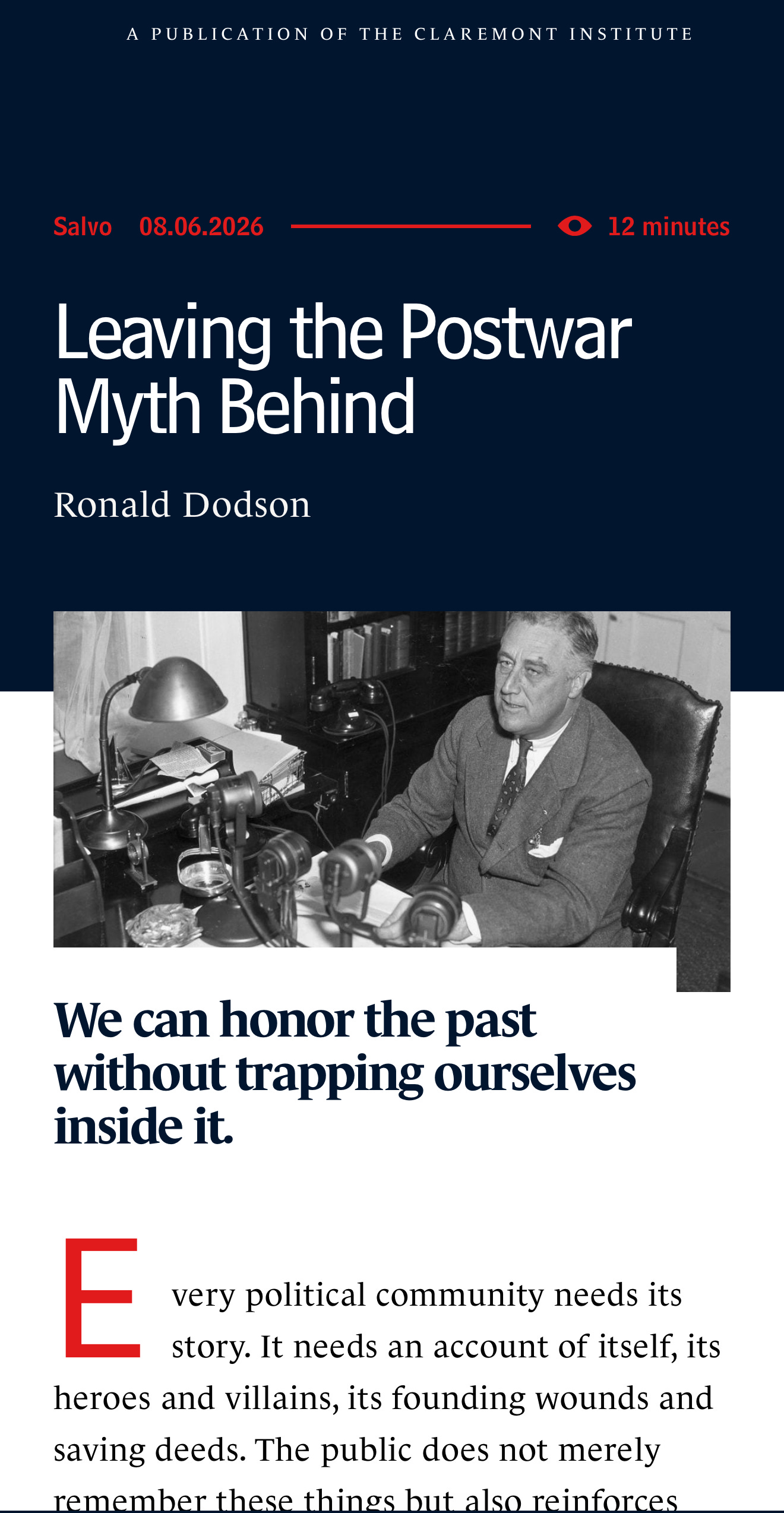
The American postwar consensus is such a story, and one that has been generating a fair amount of controversy of late. This consensus is not merely the historical fact that the United States and its allies defeated Nazi Germany and Imperial Japan, or the moral fact that this was a good thing. Nor is it merely the institutional settlement that followed the war: Bretton Woods, the United Nations, NATO, the national security state, the administrative welfare state, and the open-ended commitment to upholding the liberal international order. At its deepest level, the postwar consensus is how America came to understand itself under Franklin Roosevelt.
According to this myth, America passed through the Depression and World War II to emerge not simply victorious, but purified. The older constitutional republic, with its local attachments, constitutional restraints, inherited moral habits, and suspicion of centralized power, was reinterpreted through the drama of 1945. The new America would be universal, managerial, egalitarian, therapeutic, and global. It would secure freedom from want and fear at home while defending democracy, rights, and openness abroad. It would not merely preserve an inherited republic. It would carry forward the moral meaning of history.
This is why World War II became more than a war in American memory. It became a second founding, or more precisely, a new founding myth. The Axis became not merely defeated enemies, but symbols of metaphysical evil. The American-led order became not merely the victor’s settlement, but the institutional negation of fascism itself. To be loyal to the postwar order was to stand with democracy against tyranny, openness against hatred, equality against hierarchy, and progress against barbarism.
The power of such a myth is obvious. It gave moral coherence to a nation emerging from economic depression, total war, and global responsibility. It honored real sacrifice, named real evils, and helped explain why America should assume burdens that older republican prudence might have avoided.
The danger might have been less obvious, or less imminent, at the time. But it is becoming clearer, and more present, almost 81 years on.
Once a regime identifies its own institutions with the defeat of evil, opposition to those institutions becomes morally precarious. Dissent is no longer merely dissent. It can be recoded as reaction, extremism, disloyalty, hatred, or latent fascism. The regime’s preferred policies become signs of civic righteousness, while its opponents become symptoms of a disease the regime believes it was born to cure.
Read the rest at The American Mind: